
This is not legal advice. We describe what AI providers' terms and the GDPR say as of October 11, 2026 (laws and the UODO position checked on October 14, 2026). How this fits your contract with the client is for a lawyer who knows that contract to judge.
In a survey described by ITwiz, 69.8% of 1,100 freelancers from Poland and Central and Eastern Europe keep sensitive client data out of AI tools, and 10.8% encrypt or anonymize it first. The survey covered all freelancers, not just PPC. We were not always in that majority: we used to paste client data into AI chats ourselves.
What happens to your data in ChatGPT, Claude and Gemini depending on the plan
In ChatGPT, Claude and Gemini, the plan matters more than the provider for whether pasted client data can train the model: on personal accounts it can, on business plans and the API not by default. The same person in the same chat is under different rules on a personal account than on a business account or through the API.
We built the table from the terms and help pages of OpenAI, Anthropic and Google, checked on October 11, 2026.
| Service and plan | Can chats train the model | Thumbs feedback | How long the provider keeps data | Data processing agreement (DPA) |
|---|---|---|---|---|
| ChatGPT Free, Go, Plus, Pro | yes, unless you turn off "Improve the model for everyone" | the whole chat can be used for training despite the setting being off | temporary chat up to 30 days | we did not find one for individual accounts |
| ChatGPT Business, Enterprise, Edu, OpenAI API | no by default | we did not check separately; in the API, the organization owner can turn on data sharing | on business plans the organization decides; API up to 30 days | OpenAI DPA from January 1, 2026 for Business, Enterprise and API |
| Claude Free, Pro, Max | yes, if you allow it in settings, plus chats flagged for safety review | the whole chat is stored for up to 5 years | a deleted chat leaves the servers within 30 days | the DPA is part of the commercial terms, not the consumer terms |
| Claude for Work, Anthropic API | no by default (commercial terms) | after thumbs feedback the whole chat is kept up to 5 years and can be used for training; the plan owner can turn off feedback | API up to 30 days; a deleted chat in Claude for Work up to 30 days | Anthropic DPA in the commercial terms |
| Gemini app | yes, when Keep Activity is on; human reviewers read some chats | a chat can be used for training even with activity turned off | 18 months by default, chats seen by reviewers up to 3 years | we did not find one in the app's privacy description |
| Paid Gemini API (in the EEA, free too) | no | not applicable | logs for a limited time, to detect abuse | Google DPA |
Table sources: OpenAI help on model training, Data controls in ChatGPT, OpenAI DPA, Anthropic on training and on data retention, Anthropic commercial terms, Anthropic on business data, OpenAI on business privacy, Gemini Apps Privacy Hub, Gemini API terms.
Terms change. Before you quote this table to a client, open the source and check the date.
6 places where pasting client data can clash with your contract
Pasting client data into an AI chat can clash with your contract in six places: the chat plan, thumbs feedback, the confidentiality clause, personal data in the export, no DPA with the AI provider and deleting data after the work ends.
| Place | How to spot it | How to check |
|---|---|---|
| 1. Personal plan | you pay for the chat with a personal card or do not pay at all | the chat's privacy settings and the plan name |
| 2. Thumbs feedback | someone on the team rates answers in chats with client data | a team rule: no ratings in such chats |
| 3. Confidentiality clause | the contract defines "confidential information" and bans disclosing it to third parties | whether the contract lets you pass it to a tool provider and on what terms |
| 4. Personal data in an export or file | the file has emails, phone numbers, first and last names | whether the client instructed you to pass this data to this tool, and on which plan |
| 5. No DPA with the AI provider | the account was set up as personal, only the consumer terms were accepted | whether your account has a DPA |
| 6. Deleting data after the work ends | the client contract says to delete data when the work ends | whether you know which chats hold their data and how to delete it |
1. A personal chat account instead of a business plan or API
On a personal AI chat account, chats with client data can be used to train models, while on business plans and in the API they are not used by default. According to OpenAI help, OpenAI may use content from services for individuals, such as ChatGPT, to train models, but not by default in ChatGPT Business, Enterprise, Edu and the API.
In Claude Free, Pro and Max, chats are used to improve models if you allow it in settings, and Anthropic keeps training data for up to 5 years, not linked to your account. In the Gemini app, Google asks you not to enter confidential information that you would not want a reviewer to see.
From our practice: in October 2026, when we picked a new model to judge search terms in Marketing Workspace, the test score alone was not enough. We required that the paid API does not train on data and runs under a data processing agreement (DPA). We describe the results in our post on our AI models test for Google Ads.
How to check: in ChatGPT, open Settings, then "Data controls" and the "Improve the model for everyone" option. For a step-by-step ChatGPT guide, see how to delete ChatGPT data. In Claude, check the privacy settings. If the plan name includes Free, Go, Plus, Pro or Max, it is a personal plan, even when the agency pays for it.
2. Thumbs up or down feedback opens the chat to training
A thumbs rating on an answer in ChatGPT, Claude or the Gemini app can put the whole chat into training, even if you turned training off in settings. According to Data controls in ChatGPT, after you give feedback, "the entire conversation associated with that feedback may be used to train our models".
With feedback, Anthropic stores the whole chat for up to 5 years and may use it for training, among other uses. The Gemini app does not train on chats with activity off, unless you send feedback. In all three consumer chats, a thumbs rating can cover the whole chat with the pasted table, even with training turned off.
In Claude for Work the thumbs work the same way, but the plan owner can turn off answer feedback in the organization settings.
From our practice: in chats with client data, we did not rate answers with thumbs.
How to check: set a simple team rule: in chats with client data, we do not rate answers. If feedback is needed, describe the problem in a new chat, without the data. In Claude for Work, the plan owner can also turn off feedback for the whole organization.
3. The confidentiality clause also covers data without names
The confidentiality clause in your client contract can cover Google Ads data, even though campaign stats have no name columns. GDPR covers personal data, while campaign cost, revenue, margin or next quarter's budget are usually the client's business data (exception: a sole trader).
So for data without names, the question is not "does GDPR allow it" but "does your client contract allow it".
A confidentiality clause can define "confidential information" and ban disclosing it to third parties without consent. Whether the chat provider is such a third party, even on a business plan, depends on the wording. Anthropic's commercial terms, for example, treat customer content as the customer's confidential information, but that contract is between you and Anthropic, not you and your client.
Beyond the contract itself, the client's costs, margins and budgets may be a trade secret under Poland's Act on Combating Unfair Competition (Art. 11).
Disclosing it without the client's consent and in breach of a confidentiality duty may be an act of unfair competition. In practice, the simpler route for the client is usually contractual liability, such as a contractual penalty, if the contract provides one.
From our practice: in September 2026, an agency we talked to about Marketing Workspace asked us nine good questions about data: what data, with what permissions, where it is stored and what happens to it after the work ends.
They said no, because their client contracts did not allow an outside tool. That is a fair reason, but the talk made us ask whether such a clause also covers the AI chat you paste client reports into. If your client contract bans outside tools, an AI chat may count as one too.
How to check: find the definition of confidential information in the contract and the clause on subcontractors or tools. If the contract is silent, ask a lawyer or ask the client directly whether they agree to a specific tool and plan.
4. The export or file has personal data, and the client did not instruct you to share it
Pasting a file with personal data into an AI chat, for example leads from a Google Ads form, may need the client's instruction or their written consent to a sub-processor, if you are the processor under your client contract.
Personal data shows up in Google Ads work in leads and customer lists, among other places. You download leads from a lead form asset as a CSV with email addresses and phone numbers, and the customer list file you upload to Google Ads has columns for email, phone, first and last name.
Art. 28(2) GDPR says the processor shall not engage another processor "without prior specific or general written authorisation of the controller". This rule, however, applies to business plans and the API, where the AI provider works under a data processing agreement (DPA).
On personal plans, the chat provider is usually not a sub-processor but a separate controller: for EEA users that is OpenAI Ireland, Anthropic Ireland and Google Ireland, and chats may serve their own purposes, such as training models.
The Polish data protection authority (UODO) writes in its GDPR checklist for deploying AI (August 2026) that a provider who uses the data you enter for its own purposes becomes a controller itself to that extent (Art. 28(10) GDPR).
If you are a processor, pasting a client's leads into a personal-plan chat is therefore usually a transfer of data to another controller, which needs the client's documented instruction, not just consent to a sub-processor. Such a transfer without an instruction may be a personal data breach, which the processor reports to the client (Art. 33(2) GDPR).
Whether you are a processor depends on what you actually do with the data, not just on what the contract is called. If you download leads or upload customer lists to Google Ads on the client's instruction, you most likely are. If you only work with campaign stats, you may not process the client's personal data at all.
From our practice: Marketing Workspace pulls campaign stats from Google Ads and Meta, not leads or customer lists.
How to check: on a business plan or API, see if your client DPA lists the processors you use, or gives general consent with a duty to report changes. On a personal plan, such a list is not enough: you need the client's instruction.
Simplest: never paste personal data columns. Campaign stats analysis does not need them. We describe what breaks the numbers when you paste a report into a chat in our post on wrong numbers from AI.
5. Your account has no data processing agreement with the AI provider
A data processing agreement (DPA) with an AI provider like OpenAI, Anthropic or Google exists on business plans and the API; we found none on personal plans. The OpenAI DPA supplements the business services agreement, from January 1, 2026. Anthropic puts its DPA in the commercial terms, and Google has a DPA for the paid Gemini API.
If you are a processor, Art. 28(4) GDPR requires you to impose the same data protection duties on the sub-processor by contract (or other legal act). If it fails, the initial processor remains fully liable to the controller. Without a DPA with the AI provider, it is hard to show the client on what terms their data is processed.
From our practice: we publish the list of entities Marketing Workspace uses to process data in the MW privacy policy. A client can ask you for such a list too.
How to check: in the provider's dashboard, find which agreement your account accepted. An API account or an agency business plan has a different document than the consumer terms. Also check the contracting company (for EEA customers often an Irish one) and what US transfers rely on: standard contractual clauses in the DPA or the Data Privacy Framework.
6. After the work ends, you cannot delete the client's data
After the work ends, your client contract may require you to delete their data, and in personal AI chats, deleting a chat does not always delete everything.
Art. 28(3)(g) GDPR writes deletion into the data processing agreement: the processor, at the controller's choice, deletes or returns the data and deletes existing copies. Your client contract may have a similar clause for business data too.
Anthropic removes a deleted chat from its servers within 30 days, but keeps chats rated with thumbs for up to 5 years. In the Gemini app, chats seen by reviewers stay for up to 3 years, even after you delete activity. Before you promise a client to delete their data, check whether the chat provider lets you keep it.
On a personal plan, the provider keeps its copy of the chat as a controller: you can delete the chat in the app, but no agreement makes it delete every copy. The right to erasure (Art. 17 GDPR) belongs to the data subject, not the agency. On business plans, the DPA covers deleting or returning data after the service ends.
From our practice: clients have asked us where their data goes. When an AI chat is part of the work, the answer needs knowledge of the plan, the agreement with the provider and the places where that data sits.
How to check: try to list all the chats that hold one client's data. If the team pastes data into different chats on personal accounts, such a list may not exist. How to find and delete those chats in ChatGPT, we cover in a separate guide.
Checklist before you paste client data into an AI chat
Before you paste client data into an AI chat, answer six questions: what plan it is, whether someone will rate the chat, what the confidentiality clause says, whether the data includes people, whether you have a DPA and whether you can delete the data later.
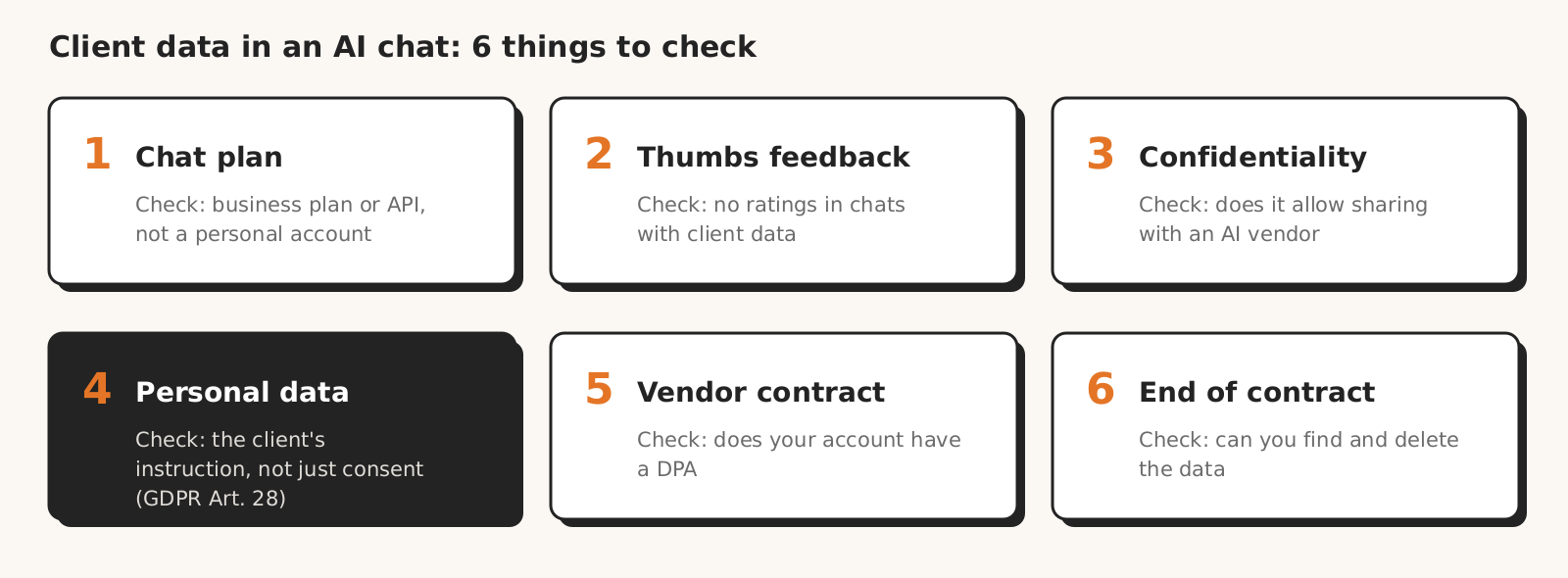
- 1Does the chat run on a business plan or through the API, not on a personal account?
- 2Does the team have a rule that chats with client data are not rated with thumbs?
- 3Does the confidentiality clause in your client contract let you pass data to a tool provider?
- 4Were the columns with emails, phone numbers, names and lead IDs removed from the export?
- 5Does the account have a DPA with the AI provider, and did the client agree to this provider as a sub-processor?
- 6Can you find and delete all chats with the client's data after the work ends?
If the answer to any question is "I don't know", the data waits until you find out. The same six answers will help when the client asks what you do with their data in AI.
In August 2026, UODO published a broader GDPR checklist for deploying AI for small and medium-sized businesses. Four of the six questions above (plan, personal data, DPA and deletion) have counterparts in its part on personal data and the AI provider. It covers only the GDPR, not the confidentiality of business data.
How Marketing Workspace processes client data
Marketing Workspace, our AI assistant for Google Ads, Meta Ads and GA4 accounts, pulls data from client accounts through the API, not by pasting it into an AI chat. If you want to describe in your client contract where their data goes, you can check these facts in our privacy policy, security documentation and changelog:
- Claude models (Anthropic) analyse the data, and Google models (Gemini), with OpenAI as a fallback, prepare part of the assistant's answers, always through paid APIs, without training on that data. Transfers outside the EEA rely on standard contractual clauses or the Data Privacy Framework.
- The server is in the EU, at OVH. We pull Google Ads and Meta campaign stats and GA4 metrics when you ask.
- You remove access with the "×" icon next to an account, or you disconnect the whole Google or Meta account. After removal, we delete the data pulled from that account from your chats, and the chat text stays (changelog, version 1.2.0).
- We publish the list of data processors in the privacy policy.
What we do not do: we do not anonymize data, so the model sees campaign names and numbers from the account.
When judging search terms, we may use Gemini through Google's paid API, which according to the Gemini API terms does not train on data; we then send only the terms and the offer description. Google does not guarantee processing in the EU. We list all providers and the data they receive in the privacy policy.
See how Marketing Workspace works

Founder of Roition, independent Google Ads API developer
Founder of Roition, with almost 3 years of Google Ads experience. Designs and builds process automation for Polish companies: system integrations, handling enquiries and quotes, AI assistants working on company data.
Frequently asked questions
Does pasting Google Ads data into ChatGPT break GDPR?
Not necessarily. Aggregated campaign stats are usually not personal data. Exceptions: a sole trader client's revenue can be the owner's personal data, the search terms report can name people someone searched for, and leads and customer lists stay personal data even with hashed emails (hashing is pseudonymization).
Is turning off training in ChatGPT settings enough?
Not always. The setting covers new chats, but thumbs feedback can put the whole chat into training despite it. The setting also does not give you a data processing agreement with the provider.
Is ChatGPT Plus or Claude Pro a business plan?
No. OpenAI counts Plus as a service for individuals, and Anthropic counts Pro and Max as consumer products. Business plans include ChatGPT Business and Enterprise and Claude for Work.
Does ChatGPT have a data processing agreement (DPA)?
On business plans and the API, yes. The OpenAI DPA applies from January 1, 2026 to ChatGPT Business, Enterprise and the API, and for an EEA customer the contracting party is OpenAI Ireland Ltd. For individual accounts such as ChatGPT Plus, we did not find a DPA.
Does Claude train on chats with client data?
In Claude Free, Pro and Max, yes, if you allow it in settings, and when a chat is flagged for safety review. In Claude for Work and the Anthropic API, not by default, but after thumbs feedback the whole chat can be used for training, unless the plan owner turns off feedback.
How long do ChatGPT, Claude and Gemini keep chats?
ChatGPT temporary chat and the OpenAI API: up to 30 days. Claude: a deleted chat leaves the servers within 30 days, one rated with thumbs stays up to 5 years. Gemini app: activity 18 months by default, 72 hours with activity off, chats seen by reviewers up to 3 years.
Does temporary chat or incognito solve the problem?
Partly. Temporary chat in ChatGPT and incognito chats in Claude do not train models, but ChatGPT keeps temporary chats for up to 30 days. It also does not change what your client contract says.
Does the free Gemini API train on my data?
Per the terms, not in the EEA. The Gemini API terms say that in the EEA, the paid services' data rules also apply to free ones. Outside the EEA, the free API uses data to improve Google products. The paid API may store data briefly in any country with Google infrastructure.
Who is liable if the AI provider fails to protect client data?
As a processor with a DPA (business plans, API), you are liable to the client for the sub-processor (Art. 28(4) GDPR). On a personal plan, the provider is usually a separate controller, so you answer for sharing data without an instruction. A lawyer judges the rest.
Is removing personal data from the export enough?
It helps with GDPR, not with the confidentiality clause. Removing emails and names is often pseudonymization, not anonymization: if a lead ID stays in the file, or the file can be linked to other data, GDPR still applies. The client's remaining costs, revenue and budgets can still fall under a confidentiality clause.
What should a client contract say about AI tools?
Work that out with a lawyer. For that talk, prepare answers: which tools and plans you use, whether the provider trains on data, where it processes it and how you will delete it after the work ends.